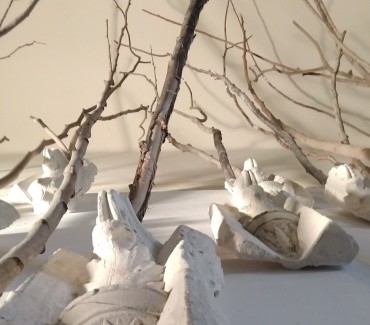
Just as erratic boulders bear witness to the ancient presence of glaciers, Vincenzo Paonessa’s “Rami Erratici” evoke distant encounters of travelers in Monferrato. The term “trovanti,” used by Alpine naturalists to define mysterious boulders, perfectly aligns with the Calabrian artist’s project. Paonessa invites us to follow his branches: to find, refind, and find ourselves in the silent contemplation of the landscape. Crossing the threshold of the churches, the discovery continues with installations of fragments and microcosms.
Slender intertwining arms drawing patterns in the sky, Vincenzo Paonessa’s “Rami Erratici” welcome wanderers, evoking the songs of ancient stones, sounds of encounters, whispered prayers, and journeys within the soul. They invite a pause, suggesting to enter these ancient churches to discover the artist’s
installations inside, summarizing his research, ancestral projections captured between earth and sky. Following Beuys’ quest for a connection between nature and art, Paonessa grafts branches onto Corinthian capitals, recalling the legend of their creation. Just as the basket left by the girl on her nurse’s tomb embraced the lush acanthus leaves and inspired the Greek sculptor Callimachus, Paonessa’s
capitals evoke the classical architecture of his Calabrian homeland and graft onto the vegetation of the Mantuan land, which has adopted him for years. Following the branches, destined to remain among the hills as sentinels and on maps as stars of a broader constellation, a path is traced in Monferrato, a magnificent land where one can lose and find oneself in a gentle wandering. This leads to the discovery of the artist’s installations, temporarily housed in the churches, where his cosmic journey finds space. In the Frammenti installations, polychrome ceramics, broken and recomposed like polymaterial chests, are explosions of stars ready to be reborn in a new form, while the “Faglie” are city or building plans (like that of “Todi’s Consolation”) translated into black clays, ready to detach from the ground to immerse in the Universe. Similarly, the “Zolle”, or building plans reworked from the Encyclopédie, printed, sewn, manipulated, become a flying carpet towards infinity. An infinity found in the monochrome “Scassi”, a sort
of safe where Paonessa keeps the most precious treasures of his microcosm, in a special corner of the vast space. In the wild Calabrian nature, as in the Monferrato hills, among the leaves, he hides and protects the emotional undergrowth of memories and his roots. Paonessa does not forget the value of irony, that lightness essential to living, showcased in the installation “Sono Cavoli”. On one hand, it pays homage to the perfection of the fractal geometric figure present in these vegetables as a narration of the infinite hidden in nature, on the other, it highlights the fragility of the ecosystem. Like the “Rami Erratici”, they are also clues of “erratics” and part of a constellation traced as in heaven so on earth.
Paola Artoni

.png)
.png)
.png)
.png)
.png)